
Spider-Man: Brand New Day Review
Few Marvel heroes have experienced as much emotional upheaval as Peter Parker. By the end of Spider-Man: No Way Home, he had saved the multiverse at the ultimate personal cost, choosing a life where the people he loved no longer remembered him. Spider-Man: Brand New Day picks up that thread without immediately chasing another universe-ending catastrophe. Instead, it focuses on a quieter, lonelier Peter Parker who has accepted that being Spider-Man means carrying burdens nobody else can understand.
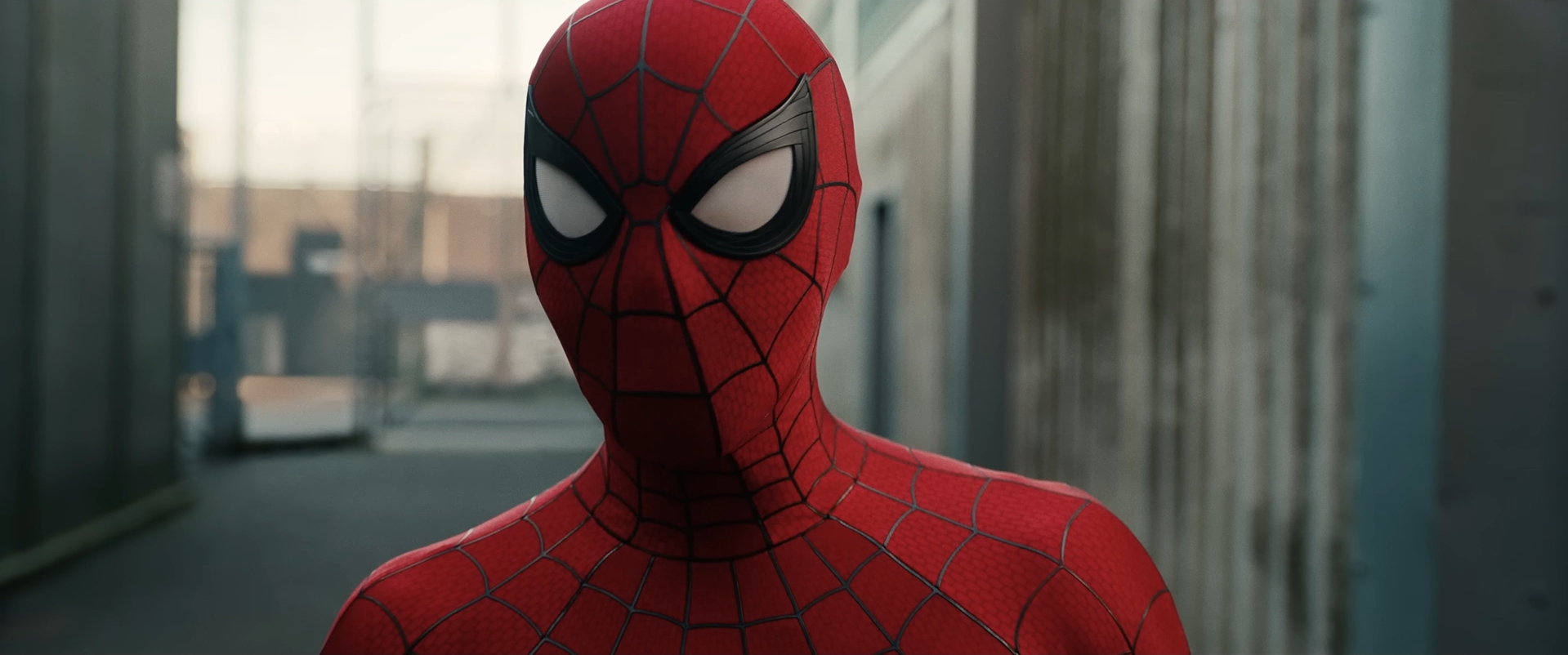
Directed by Destin Daniel Cretton, the fourth Spider-Man film Spider-Man: Brand new Day starring Tom Holland avoids relying solely on nostalgia or multiverse fan service. It instead attempts something Marvel has rarely prioritized in recent years: allowing its protagonist to breathe. The result is a superhero film that feels more grounded, emotionally mature, and character-driven while still delivering the large-scale action audiences expect from the franchise.
The film doesn’t reinvent the superhero genre, nor does it completely escape some of Marvel’s familiar storytelling habits. However, it succeeds where it matters most by reminding audiences why Peter Parker remains one of the most relatable heroes in comic book history.
Story (Spoiler-Free)
Four years after the events of No Way Home, Peter Parker has become a full-time neighborhood Spider-Man in a city that no longer knows his real identity. With MJ and Ned living lives that no longer include him, Peter isolates himself, throwing everything into protecting New York. That emotional void becomes the foundation of the film’s narrative, forcing him to confront not only dangerous new threats but also the consequences of living entirely behind the Spider-Man mask.
Rather than rushing from one explosive set piece to another, Spider-Man: Brand New Day spends considerable time exploring Peter’s loneliness. His relationships feel fragile, every interaction carries emotional weight, and the screenplay consistently reminds viewers that the greatest sacrifice wasn’t defeating villains—it was losing his personal life.
The story gradually introduces a mysterious threat that pushes Peter into unfamiliar territory. While the larger conflict ultimately embraces classic Marvel spectacle, the emotional journey remains the film’s strongest element. The screenplay continuously asks whether Peter Parker can ever truly have a normal life or whether Spider-Man has permanently consumed his identity.
That central conflict gives the movie a maturity that separates it from many recent MCU entries.
Direction: Destin Daniel Cretton Gives Spider-Man: Brand New Day Room to Grow
Destin Daniel Cretton approaches Spider-Man differently from Jon Watts. Instead of emphasizing constant humor and rapid-fire pacing, Cretton slows the narrative enough to let important emotional moments resonate. Conversations are allowed to breathe, quieter scenes receive as much attention as action sequences, and Peter’s internal struggles are treated as seriously as the external danger facing New York.
This shift in filmmaking style benefits the character enormously. The emotional stakes feel personal rather than manufactured, and the director demonstrates confidence in Tom Holland’s ability to carry scenes without relying on visual spectacle every few minutes.

Action remains an essential ingredient, and several sequences showcase Spider-Man’s agility with impressive camera movement and inventive choreography. Yet the film is at its strongest when it remembers that Spider-Man has always been more than swinging through skyscrapers. Peter’s humanity becomes the story’s true superpower.
There are moments where the pacing loses momentum, particularly during portions of the second half where multiple subplots compete for attention. Some narrative beats feel designed to establish future MCU stories rather than serving the immediate film. Fortunately, those interruptions never completely derail the emotional core.
Screenplay in Spider-Man: Brand New Day
Chris McKenna and Erik Sommers craft a screenplay that consciously distances itself from multiverse excess. Instead of constantly escalating the stakes, they return to the personal storytelling that originally made audiences connect with Peter Parker.
Dialogue feels natural throughout much of the film, balancing humor with vulnerability. Peter’s conversations often reveal more through silence than exposition, and several emotionally charged exchanges leave a stronger impression than the biggest action scenes.
The screenplay isn’t flawless. Certain supporting characters receive less development than expected, and some late-film revelations arrive more conveniently than organically. Nevertheless, the writing consistently understands what audiences want from Spider-Man, not simply another superhero saving the world, but a young man trying to preserve his humanity while carrying impossible responsibility.
That emotional clarity gives Spider-Man: Brand New Day a distinct identity within the MCU. Rather than attempting to outdo No Way Home in scale, it wisely chooses to deepen Peter Parker as a character. It’s a creative decision that pays off more often than not and positions the franchise for a compelling new chapter.
Read more: Spider-Man: Brand New Day – Wikipedia
Cast Performances
Tom Holland Delivers His Most Mature Spider-Man Performance in Spider-Man: Brand New Day
If Spider-Man: Brand New Day belongs to anyone, it’s Tom Holland. After nearly a decade in the role, Holland no longer has to prove that he can balance Peter Parker’s awkward charm with Spider-Man’s heroics. Instead, he pushes the character into emotionally unfamiliar territory.
Peter is no longer the optimistic teenager audiences met in Homecoming. He’s older, more isolated, and carrying emotional scars that never fully healed after the events of No Way Home. Holland embraces that evolution with remarkable restraint. Rather than relying on exaggerated emotional outbursts, he communicates Peter’s loneliness through subtle expressions, body language, and quiet conversations.

The action sequences remind audiences why Holland remains one of the MCU’s most athletic performers, but it’s the quieter scenes that linger. Whether Peter is questioning the cost of his sacrifices or trying to reconnect with fragments of the life he lost, Holland gives the character an emotional authenticity that anchors the film.
Many critics have called Spider-Man: Brand New Day his strongest performance as Spider-Man to date, and it’s easy to understand why. The film demands more dramatic range than previous entries, and Holland rises to the occasion.
Zendaya Makes Every Scene Count in Spider-Man: Brand New Day
Although Zendaya has comparatively less screen time than some fans might expect, she once again proves why MJ remains one of the franchise’s emotional pillars.
The relationship between Peter and MJ is fundamentally different this time. Without revealing spoilers, the screenplay explores the heartbreaking consequences of forgotten memories and missed opportunities. Zendaya handles those moments with remarkable emotional control, allowing the audience to feel Peter’s pain without resorting to melodrama.
Several reviewers have highlighted that she elevates the film whenever she appears, and it’s difficult to disagree. Even brief interactions carry emotional weight because of the chemistry she shares with Tom Holland.
Other entertainment from Zendaya: Euphoria Season 3: Release Timeline, Story Direction, Cast Updates & Everything Fans Need to Know
Sadie Sink Brings Fresh Energy in Spider-Man: Brand New Day
Joining an established superhero franchise is never easy, but Sadie Sink fits naturally into Marvel’s version of New York.
Without diving into spoiler territory, her character introduces a fresh dynamic that challenges Peter in unexpected ways. Sink avoids becoming just another supporting figure in the MCU machine. Instead, she delivers a performance that feels emotionally grounded while also matching the film’s more intense dramatic moments.
She brings confidence, vulnerability, and unpredictability to the role, making her one of the movie’s standout additions.
Jon Bernthal Nearly Steals in Spider-Man: Brand New Day
Jon Bernthal’s return as Frank Castle, better known as the Punisher, injects an entirely different energy into the film.
Where Peter still believes people deserve second chances, Frank represents uncompromising justice. Their ideological conflict creates some of the screenplay’s strongest dialogue and most memorable confrontations.

Bernthal never overplays the character. His performance is intense without becoming cartoonishly violent, creating an effective contrast with Spider-Man’s optimism. Their scenes together provide both thrilling action and meaningful philosophical debate about what it truly means to protect innocent people.
Supporting Cast in Spider-Man: Brand New Day
Jacob Batalon returns with the warmth and humor fans expect, while Mark Ruffalo provides another dependable performance that helps expand Peter’s place within the larger MCU. Michael Mando finally receives material worthy of his long-awaited return, and Tramell Tillman leaves a surprisingly strong impression despite limited screen time. Collectively, the supporting cast ensures that even secondary characters contribute meaningfully to the narrative rather than feeling like simple setup for future Marvel projects.
Cinematography
One of Spider-Man: Brand New Day‘s biggest strengths is its visual identity. Instead of overwhelming audiences with constant CGI spectacle, the cinematography emphasizes practical environments, recognizable New York locations, and intimate character moments.
The camera frequently stays close to Peter, allowing viewers to experience his isolation firsthand. Wide aerial shots of Spider-Man swinging through Manhattan remain exhilarating, but they’re balanced by quieter compositions that reflect the emotional loneliness at the heart of the story.
Nighttime action sequences benefit from richer lighting than many recent MCU films, making fights easier to follow while preserving a grounded atmosphere.
Visual Effects
Marvel’s visual effects have faced criticism in recent years, but Spider-Man: Brand New Day represents a noticeable improvement.
Spider-Man’s web-swinging feels fluid, the digital environments integrate more naturally with practical photography, and the larger action sequences avoid the weightless look that has affected some recent superhero productions.
While a handful of CGI-heavy moments reveal their digital origins, the overall presentation is polished enough to keep audiences immersed. The effects support the story instead of overshadowing it.
Music and Background Score
The score complements the film’s emotional direction rather than trying to dominate every scene.
Quiet piano motifs and restrained orchestral themes reinforce Peter’s isolation, while the action cues provide the excitement expected from a Spider-Man adventure. The soundtrack understands when to step forward and when silence is more powerful than music.
Although it may not produce an instantly iconic superhero theme, the score effectively supports the film’s emotional journey.
Editing
The editing keeps the action coherent and the emotional beats impactful. Fight sequences maintain clarity without resorting to frantic cutting, allowing audiences to appreciate Spider-Man’s agility and choreography.
However, the film’s nearly two-and-a-half-hour runtime occasionally becomes noticeable. Certain subplots could have been condensed, and a tighter second act might have improved overall pacing. Even so, the narrative rarely loses sight of Peter Parker’s personal journey, preventing the film from feeling directionless.
Production Design
The production design deserves particular praise for making New York feel alive again. From cramped apartments and neighborhood streets to larger-scale set pieces, every location reinforces the idea that Spider-Man is a hero deeply connected to ordinary people.
Rather than relying exclusively on futuristic technology or cosmic environments, the filmmakers embrace a grounded urban aesthetic that recalls some of the character’s best comic-book stories. That decision strengthens the film’s identity and helps distinguish it from many recent MCU entries.
Emotional Impact of Spider-Man: Brand New Day
The greatest achievement of Spider-Man: Brand New Day is that it remembers what has always separated Spider-Man from most superheroes. Peter Parker is never defined by his powers alone. His struggles, sacrifices, and constant attempts to balance heroism with an ordinary life remain the emotional foundation of the character.
The film leans into that idea by giving Peter difficult choices that carry genuine emotional consequences instead of relying solely on large-scale destruction or multiversal spectacle. Even during its biggest action sequences, the narrative repeatedly returns to the personal cost of being Spider-Man. That emotional focus gives the story a stronger identity than many recent superhero blockbusters.
At the same time, the film occasionally stretches its runtime with subplots that don’t always receive satisfying payoffs. While those moments don’t undermine the overall experience, they do interrupt the momentum established during the strongest character-driven scenes.
You may also like: 10 Shocking Truths Behind the Hollywood Diversity Backlash That’s Dividing Audiences
What Works in Spider-Man: Brand New Day
- Tom Holland delivers a confident and emotionally mature performance.
- The film places Peter Parker’s personal journey ahead of spectacle.
- Well-directed action sequences with clear choreography.
- Strong production values, polished visual effects, and impressive cinematography.
- A grounded tone that feels refreshing after years of multiverse-heavy storytelling.
- Emotional moments generally land because they grow naturally from Peter’s character rather than forced sentimentality.
What Doesn’t Work
- The pacing slows noticeably during portions of the second half.
- Some supporting characters deserved more development.
- Certain story threads feel designed to set up future MCU projects instead of fully serving this film.
- The lengthy runtime occasionally weakens the narrative momentum.
Final Verdict
Rather than attempting to recreate the event-level excitement of Spider-Man: No Way Home, Spider-Man: Brand New Day chooses a more intimate direction. That creative decision won’t satisfy viewers looking for nonstop spectacle, but it gives Peter Parker room to evolve in meaningful ways.
The film succeeds because it understands that audiences connect with Spider-Man not simply because he defeats villains, but because he continues moving forward despite extraordinary personal sacrifice. While the screenplay isn’t without flaws, its emotional core, strong lead performance, and grounded storytelling make it a worthwhile addition to the Spider-Man franchise.
For longtime Spider-Man fans, this chapter offers a promising foundation for whatever comes next.
CineSyncs Rating to Spider-Man: Brand New Day
★★★★☆ (4/5)
Verdict: A confident, character-driven Spider-Man adventure that prioritizes emotion over excess. Despite some pacing issues, Spider-Man: Brand New Day delivers one of the franchise’s most mature stories and reminds audiences why Peter Parker remains Marvel’s most relatable hero.
Frequently Asked Questions
Is Spider-Man: Brand New Day worth watching?
Yes. If you enjoy character-focused superhero films that balance emotional storytelling with exciting action, Spider-Man: Brand New Day is worth watching.
Do I need to watch Spider-Man: No Way Home first?
While the film introduces its own story, watching Spider-Man: No Way Home provides important context for Peter Parker’s emotional journey.
Is Spider-Man: Brand New Day family-friendly?
Like previous MCU Spider-Man films, it is broadly suitable for teenagers and families, though younger children may find some action sequences intense.
Does the movie have post-credit scenes?
Yes. As with most Marvel Studios releases, viewers should remain seated until the credits finish.
Is this Tom Holland’s best Spider-Man performance?
Many viewers and critics consider it among Holland’s strongest performances because of the greater emotional depth the role demands.