
Drishyam 3 Review: The Final Game Begins
There are very few Indian film franchises where a simple date can make an entire audience suspicious. “2 October” has become inseparable from Vijay Salgaonkar, and that is precisely why Drishyam 3 Review is not an ordinary sequel review. Abhishek Pathak’s Drishyam: The Conclusion arrives with the difficult responsibility of closing a story that has already played with police investigations, missing evidence, family loyalty and the audience’s own sense of morality. The Hindi franchise has now reached its final chapter, with Ajay Devgn returning as Vijay alongside Tabu, Shriya Saran, Jaideep Ahlawat and Prakash Raj. The film released theatrically on October 2, 2026, and runs for approximately 150 minutes.

What makes this Drishyam 3 Review particularly interesting is that the film does not simply try to repeat the trick that made the first two movies popular. The central attraction is still Vijay’s ability to stay several moves ahead of the people investigating him, but this time the filmmakers understand that the audience already knows the rules of the game. We know Vijay is intelligent. We know his family is hiding something. We know the police will keep looking for the missing pieces. The real question is whether the franchise can still make us doubt what we think we know. For large stretches, the answer is yes.
Drishyam 3 Story: What Is The Film About?
Without entering spoiler territory, Drishyam: The Conclusion once again puts Vijay Salgaonkar and his family under pressure as the past refuses to remain buried. The events surrounding Sameer Deshmukh continue to cast a shadow over the family, while Meera Deshmukh, played by Tabu, is drawn back into the case. This time, however, the investigation gets a new source of energy through Jaideep Ahlawat’s Rajveer Singh Tomar, a Crime Branch officer who approaches Vijay from a different angle.
That setup is important to this Drishyam 3 Review because the film’s suspense does not depend entirely on discovering what happened. The audience already understands the broad circumstances from the previous films. Instead, the screenplay concentrates on how Vijay responds when another person begins pulling at the threads of his carefully constructed story. The tension therefore comes from watching two intelligent characters study each other, test each other’s weaknesses and attempt to predict the next move.
The screenplay also benefits from not simply adapting another existing Malayalam chapter. Unlike the earlier Hindi installments, Drishyam: The Conclusion uses an original Hindi story and screenplay developed for this film, with story by Abhishek Pathak and screenplay by Aamil Keeyan Khan, Abhishek Pathak and Parveez Shaikh.
Drishyam 3 Review: Does The Story Actually Work?
This is where the Drishyam 3 Review becomes more complicated than simply calling the movie another suspense thriller. The story works because the writers understand the franchise’s biggest advantage: Vijay is not interesting because he commits extraordinary acts; he is interesting because he thinks like an ordinary man who has been forced into extraordinary circumstances.
The new investigation gives the character another opportunity to demonstrate that intelligence, but it also creates a more conventional cat-and-mouse structure. Some developments feel deliberately designed to keep the audience guessing, while a few turns can feel convenient once you start examining how all the pieces fit together. This is one area where the film occasionally asks the viewer to accept the mechanics of the thriller rather than completely believe them.
Still, the Drishyam 3 Review cannot ignore how effectively the screenplay understands audience expectations. The film knows that viewers will be looking for clues. It knows that even a seemingly harmless conversation may become important later. It knows that Vijay’s expressions can carry more information than a page of dialogue. That awareness creates a fun relationship between the film and its audience.
Abhishek Pathak’s Direction
Abhishek Pathak had a particularly difficult job with this installment. He had to make a new film feel familiar enough to belong to the Drishyam franchise without making it feel like a recycled version of the previous two movies. The direction succeeds most when it allows scenes to breathe and lets suspicion develop naturally rather than immediately announcing the importance of every detail.
One of the strengths highlighted in several reviews is the film’s ability to maintain momentum, particularly as Vijay gets pushed into increasingly difficult situations. The Indian Express praised the way Pathak balances suspense, emotional beats and dramatic turns, while Hindustan Times noted that the film moves quickly toward its central conflict instead of spending excessive time setting everything up.
For this Drishyam 3 Review, that pacing decision matters. A franchise like this can easily become trapped by exposition because every new mystery requires reminders about previous events. Pathak generally avoids allowing the movie to become a long recap session. Instead, information is introduced when it becomes dramatically useful.
Ajay Devgn as Vijay Salgaonkar
Ajay Devgn remains the foundation of this Drishyam 3 Review because Vijay Salgaonkar has always been a character built around restraint. He does not need to announce that he is clever. His stillness does the work.
Devgn understands that Vijay’s biggest weapon is his ability to appear ordinary. Even when the character is calculating his next move, the performance rarely becomes exaggerated. The eyes, pauses and controlled reactions create the impression of a man constantly calculating the consequences of every decision.
That becomes particularly effective opposite Jaideep Ahlawat. Devgn does not attempt to overpower the investigation scenes through conventional star presence. Instead, Vijay becomes interesting because he knows that the smallest mistake could expose everything.
Several critics have specifically praised Devgn’s performance, with the Indian Express highlighting his restrained portrayal of Vijay and NDTV describing him as one of the film’s central attractions.
Also Read: Toxic OTT Release Date (2026): When and Where to Watch Yash’s Toxic Online
Jaideep Ahlawat Is The Freshest Ingredient
If Ajay Devgn gives the franchise its continuity, Jaideep Ahlawat provides Drishyam 3 with its freshest dramatic energy. His Rajveer Singh Tomar is not simply another police officer inserted into the story to repeat the function of previous investigators. Ahlawat gives the character confidence, intensity and a personality that makes his scenes immediately watchable.
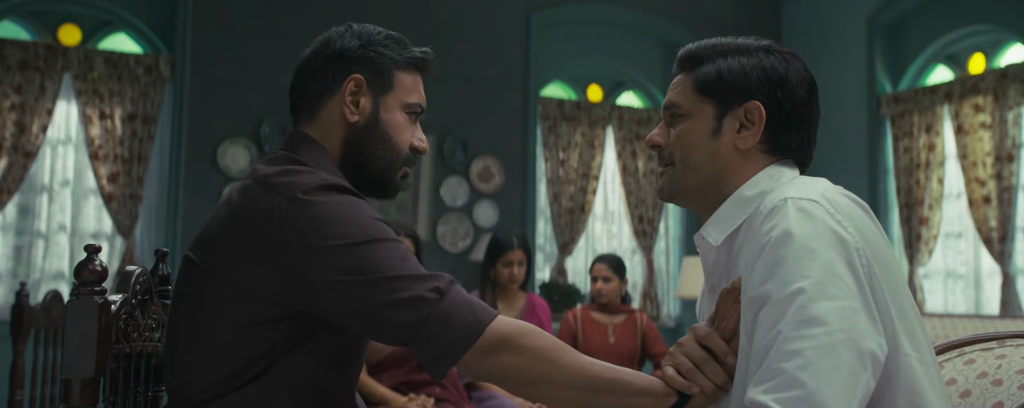
This is one of the most enjoyable aspects of the Drishyam 3 Review. The film becomes more exciting whenever Vijay and Rajveer share the screen because their conflict is based on observation rather than action. Neither character needs to raise his voice to establish dominance. They are constantly measuring one another.
NDTV specifically highlighted Ahlawat’s performance, while other reviews have also identified the Devgn-Ahlawat dynamic as one of the film’s strongest elements.
Tabu and Shriya Saran
Tabu’s Meera Deshmukh remains emotionally important to the story because her connection to the original tragedy prevents the investigation from becoming a purely intellectual puzzle. There is genuine anger and grief behind her decisions, and Tabu brings the necessary weight to the character.
The Drishyam 3 Review also needs to acknowledge Shriya Saran, because Nandini is once again positioned as one of the emotional links between Vijay’s elaborate plans and the family he is desperately trying to protect. Her role is not as dominant as Vijay’s, but the family dynamic remains essential to understanding why he continues to fight.
Prakash Raj, Rajat Kapoor, Ishita Dutta and the returning supporting cast add further texture to the investigation. The film has a sizeable ensemble, but the narrative generally understands which characters need to occupy the foreground.
Screenplay and Suspense
The screenplay is where this Drishyam 3 Review becomes most positive. A mystery thriller cannot survive on atmosphere alone. It needs information control, and Drishyam: The Conclusion understands the value of withholding the right detail at the right moment.
The writers repeatedly create situations where the viewer believes they have understood the direction of the story, only for another piece of information to change the calculation. Not every twist carries the same impact, and some developments are easier to anticipate than others, but the screenplay maintains enough uncertainty to prevent the movie from becoming predictable.
The film’s biggest achievement is that it does not completely depend on one giant twist. Instead, the suspense accumulates through smaller discoveries and changing relationships. That approach gives the final stretch a sense of escalation rather than making the entire movie feel like a two-hour wait for one reveal.
Cinematography and Production Design
Sudhir Kumar Chaudhary’s cinematography gives the film the visual polish expected from a contemporary Hindi thriller. The camera remains functional rather than excessively showy, which suits a story built around observation and suspicion. Locations, interiors and nighttime sequences are photographed in a way that supports the atmosphere without distracting from the characters.
The production design by Priya Suhas also contributes to the realism of Vijay’s world. The film does not need extravagant sets to create tension. Its strongest environments are ordinary spaces where an apparently normal conversation can suddenly feel dangerous.
That grounded visual approach strengthens the Drishyam 3 Review because the film works best when it feels like a domestic crime drama rather than an oversized action spectacle.
Music, Background Score and Editing
The music is another important technical component. Ravi Basrur, Rochak Kohli and Karma are credited as composers, while Amar Mohile handles the background score.
The background score plays a particularly significant role in building suspense. However, this is also an area where opinions among critics have differed. The Indian Express found the background music excessively loud at points, while Film Information praised Amar Mohile’s background score and Sandeep Francis’ editing.
For my Drishyam 3 Review, the editing deserves particular attention. Sandeep Francis keeps the narrative moving and understands that suspense depends on timing. A revelation arriving too early can destroy tension, while one arriving too late can make a film feel artificially stretched. Drishyam: The Conclusion generally finds the middle ground.
The Climax: Does Drishyam 3 Deliver?
The climax is obviously the section most people will want to discuss after watching the movie, but this Drishyam 3 Review will remain spoiler-free.
What can be said is that the final act understands what audiences expect from a Drishyam movie. The pressure increases, the investigation becomes more aggressive, and Vijay’s options become increasingly limited. Several early reactions and reviews have specifically singled out the final portion and climax for maintaining tension.
The important thing is not simply whether the final twist is surprising. The real question is whether the ending feels like a meaningful conclusion to Vijay’s journey. On that front, the film makes a genuine effort to close the central conflict rather than leaving the franchise suspended indefinitely.
What Works in Drishyam 3?
The strongest element of the film is the Vijay-Rajveer confrontation. Ajay Devgn and Jaideep Ahlawat create the kind of controlled tension that the franchise needs. The screenplay also benefits from being written specifically for this Hindi continuation rather than simply reproducing an existing storyline.
The second major strength is the film’s understanding of its audience. Drishyam 3 knows that viewers will search for clues, question seemingly insignificant details and compare the new mystery with the previous films. Instead of fighting that expectation, the screenplay uses it as part of the viewing experience.
The third strength is the performances. Devgn remains convincingly restrained, Ahlawat injects fresh energy, and Tabu brings emotional intensity whenever the story moves back toward the original tragedy.
What Doesn’t Work?
The Drishyam 3 Review would be incomplete without discussing the film’s weaknesses. The biggest issue is that not every twist feels equally organic. Some developments are satisfying because they emerge from character behaviour, while others feel more like screenplay mechanisms designed to move the plot toward its next revelation.
The emotional side of Vijay’s family life also receives less attention than it did in earlier installments. This is partly understandable because the third film is more aggressively structured around investigation and confrontation, but it means the family drama sometimes feels secondary.
There are also moments when the background score pushes the tension harder than the scene itself requires. Some critics have pointed this out, although other Drishyam 3 review have praised the score’s contribution to the thriller atmosphere.
Is Drishyam 3 Worth Watching?
For anyone who has followed Vijay Salgaonkar from the beginning, the Drishyam 3 Review ultimately comes down to whether this final chapter gives the character enough room for one last battle of intelligence. It does.
This is not a film that completely reinvents the franchise. Instead, it takes the familiar ingredients—family, secrecy, investigation, evidence and Vijay’s ability to anticipate his opponents—and rearranges them into another mystery. That familiarity can occasionally work against the movie, but it is also what makes the experience immediately recognisable.
The theatrical experience is particularly valuable because the film’s suspense depends on audience reactions. The pauses before revelations, the sudden shifts in information and the tension surrounding Vijay’s decisions work better when experienced with a crowd.
Also Read: 13 Best Hindi Web Series for Family Watching: Fun, Feel-Good Shows You Can Watch Together
Drishyam 3 Review: Final Verdict
After three films, Vijay Salgaonkar’s story has reached the point where another clever escape would risk feeling repetitive. Drishyam: The Conclusion therefore has to do more than produce another twist. It has to make the audience feel that this particular chapter needed to exist.
My Drishyam 3 Review is that the film largely succeeds because it introduces a fresh investigative opponent while retaining the characters audiences have spent years following. Ajay Devgn remains perfectly suited to Vijay’s quiet intelligence, while Jaideep Ahlawat gives the final chapter a new source of tension. Tabu adds emotional weight, and Abhishek Pathak keeps the narrative moving with a reasonably tight grip on suspense.

It is not flawless. Some twists feel more convenient than inevitable, the emotional family material could have been stronger, and the background score can sometimes overstate moments that are already working. But the film understands the basic promise of the franchise: make the audience question what they know, then make them wait for the next piece of information.
That is ultimately why this Drishyam 3 Review lands on the positive side. The movie may not completely redefine the franchise, but it gives Vijay Salgaonkar another intelligent game to play and provides a conclusion that feels substantially more purposeful than a simple extension of the brand.
CineSyncs Rating: 3.5/5
Drishyam 3 Review FAQs
Is Drishyam 3 worth watching?
Yes, particularly for viewers who have watched Drishyam and Drishyam 2. The film continues Vijay Salgaonkar’s story with a new investigation led by Jaideep Ahlawat’s Rajveer Singh Tomar and builds its suspense around whether Vijay can protect his family again.
Who directed Drishyam 3?
Drishyam: The Conclusion is directed by Abhishek Pathak. The screenplay is credited to Aamil Keeyan Khan, Abhishek Pathak and Parveez Shaikh, with dialogues by Aamil Keeyan Khan.
Who stars in Drishyam 3?
The principal cast includes Ajay Devgn as Vijay Salgaonkar, Tabu as Meera Deshmukh, Shriya Saran as Nandini Salgaonkar, Jaideep Ahlawat as Rajveer Singh Tomar and Prakash Raj, alongside Rajat Kapoor and Ishita Dutta.
What is the runtime of Drishyam 3?
The film’s CBFC-reported runtime is 150 minutes, or 2 hours and 30 minutes. Some international cinema listings show slightly different runtimes, so listings can vary by market.
Is Drishyam 3 based on the Malayalam Drishyam 3?
The Hindi Drishyam: The Conclusion is presented as an original Hindi continuation rather than a direct remake of the Malayalam third film. Its story is credited to Abhishek Pathak, with a separate Hindi screenplay by Aamil Keeyan Khan, Abhishek Pathak and Parveez Shaikh.
Where can I watch the Drishyam 3 trailer?
The official trailer was released by Star Studios and is available on YouTube.
Watch the official Drishyam: The Conclusion trailer
Drishyam 3 Review: Should You Watch It In Theatres?
If you have followed Vijay Salgaonkar’s journey through the previous two films, the theatrical experience makes sense because the movie is designed around suspense, audience reactions and the gradual unveiling of information. The film is currently playing in cinemas following its October 2, 2026 release.