
There was a very specific kind of excitement surrounding The Paradise before its release. Nani and Srikanth Odela were returning after Dasara, a collaboration that worked because it felt raw, unexpected and deeply rooted in its world. This time, however, everything had been scaled up: a much larger production, a darker setting, a physically transformed Nani, bigger action sequences and considerably higher expectations.
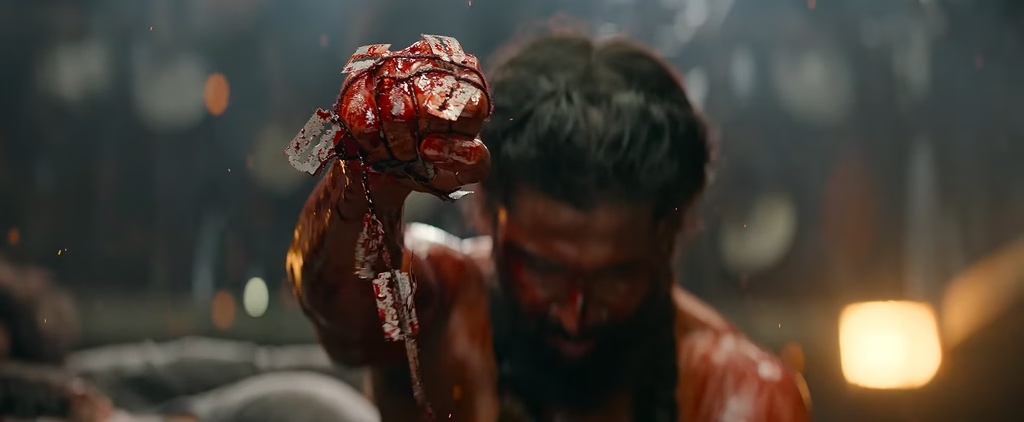
After watching the finished film, my reaction is complicated. The Paradise certainly looks like a film that cost a lot of money, and there are stretches where Srikanth Odela’s filmmaking ambition is impossible to ignore. But when the spectacle settles down, the screenplay underneath it feels surprisingly familiar. That becomes the central issue in The Paradise Movie Review: the film has the appearance of something epic, but the writing rarely reaches the same level as the filmmaking around it.
Released theatrically on September 24, 2026, The Paradise runs for approximately 2 hours and 45 minutes and stars Nani as Jadal, alongside Mohan Babu, Raghav Juyal, Kayadu Lohar and Sonali Kulkarni. Srikanth Odela directs the film and has co-written it with Thota Srinivas and Vinay Sagar Jonnala. The story is set in 1980s Secunderabad and revolves around the Savaari community, a marginalized group struggling without legal identity or the rights that come with citizenship.
Jadal gradually becomes the figure around whom their fight for recognition and freedom begins to take shape. The premise is actually strong enough to support a gripping political-period action drama. Unfortunately, The Paradise Movie Review has to acknowledge that the film repeatedly chooses familiar mass-cinema shortcuts when its central idea needed more character development and sharper writing.
The Paradise Movie Review: Story and Premise
The foundation of The Paradise is one of its most interesting elements. The Savaari community exists on the margins of society, deprived of documentation, recognition and the basic rights that define citizenship. They live under the shadow of Shikanja Malik, played by Mohan Babu, a feudal power who exercises control over the community.
Jadal grows up inside this environment, and the story gradually turns him into the reluctant figure who is expected to challenge the system. It is a familiar saviour narrative, but there is nothing inherently wrong with using a familiar structure. The challenge is making the audience emotionally invest in the characters rather than simply waiting for the next violent confrontation. In that regard, The Paradise Movie Review finds the premise considerably stronger than the screenplay that eventually develops it.
That is why The Paradise Movie Review cannot simply celebrate the film for having an ambitious premise. A story about a marginalized community fighting for legal identity should have enormous emotional potential. The audience should understand what these people have lost, what they fear, what they want and why Jadal’s rise matters to them. Some of those ideas are present, but the film frequently moves past them before they have had enough time to become emotionally meaningful. Instead of allowing the social conflict to naturally create the drama, the screenplay repeatedly turns toward action and spectacle. The result is a film where the setting is more interesting than several of the characters living inside it.
Nani Is the Biggest Reason to Watch The Paradise
There is very little doubt about the strongest element of the film: Nani. His transformation into Jadal is not cosmetic. The actor changes his physical appearance, hairstyle, body language and overall screen presence to create a character who feels shaped by his environment. The braided hair, beard and leaner physicality immediately separate Jadal from the more familiar versions of Nani that audiences have seen over the years. More importantly, Nani understands that Jadal cannot simply be played as another conventional mass hero. There is an underlying frustration and vulnerability in the character that occasionally emerges through the aggression. Multiple reviews have similarly highlighted Nani’s physical commitment and performance as the film’s major strength.
The action sequences benefit enormously from that commitment. Nani does not look like an actor waiting for the stunt performers to create the hero moments around him. He appears physically involved in the film’s brutal action language, and that gives several sequences genuine impact. His body language is particularly effective because Jadal is supposed to be someone who has grown up around violence rather than someone who suddenly becomes an action hero halfway through the story. That distinction makes his performance one of the more convincing aspects of The Paradise Movie Review. Even when the writing becomes repetitive, Nani continues to make the character watchable.
The problem is that Nani’s performance occasionally feels better than the material surrounding it. The actor has clearly invested heavily in Jadal, but the screenplay does not always give him enough emotionally complex material to justify that investment. There are moments when the film seems to believe that changing Nani’s appearance and putting him into increasingly brutal action scenes is enough to establish character depth. It is not. A transformation becomes memorable when the writing gives the actor something meaningful to transform into. In The Paradise Movie Review, Nani does the difficult part, but the screenplay does not always meet him halfway.
The Mother-Son Emotion Could Have Been the Film’s Heart
One of the more promising aspects of The Paradise is the relationship between Jadal and his mother, played by Sonali Kulkarni. Whenever the film slows down and focuses on that relationship, it becomes considerably more interesting. The mother is not simply another supporting character in these moments; she provides a glimpse into the personal history behind Jadal’s anger. Those scenes suggest that there is a more intimate story buried underneath the larger political and action narrative.
Sonali Kulkarni brings the required emotional weight to the role, particularly in the earlier portions of the film. Unfortunately, the character gradually becomes less important as the story expands. That is one of the recurring frustrations highlighted in The Paradise Movie Review. The movie has several emotional threads that could have made the action matter, but instead of strengthening those threads as the conflict escalates, the screenplay increasingly prioritizes spectacle. The mother-son relationship therefore feels like an underused opportunity rather than a fully developed emotional backbone.
Mohan Babu and Raghav Juyal Deserved Stronger Characters
Mohan Babu plays Shikanja Malik, the feudal antagonist whose power forms one of the central obstacles in Jadal’s journey. The actor has the screen presence required for this kind of role, and his introduction establishes an immediate sense of authority. Unfortunately, the character is not developed with the same confidence. Shikanja is positioned as an important force within the story, yet the screenplay leaves him underused for long stretches. That weakens the central conflict because the audience needs to understand not only that the villain is powerful, but also why he is psychologically and dramatically difficult for the protagonist to defeat.
Raghav Juyal, making his Telugu debut as Vikram Malik, has a different problem. After his performance in Kill, expectations were naturally high for his move into a major Telugu action film. He brings physical energy and screen presence to The Paradise, but his character does not have enough complexity to take full advantage of what the actor can do. The Paradise Movie Review therefore has to count the supporting cast as one of the film’s major missed opportunities. When you assemble actors with distinctive screen personalities, the writing needs to give them characters capable of creating friction, unpredictability and emotional tension.
The Paradise Movie Review: The Action Is the Film’s Most Reliable Element
If you are buying a ticket specifically for action, The Paradise has plenty to offer. The film’s action choreography is one of its most consistently impressive technical departments. The fight sequences are staged with considerable physicality and are varied enough that they do not all feel like repetitions of the same confrontation. Several reviews have also identified the action choreography as one of the film’s technical strengths.
The problem is not that there is too much action in an action movie. The problem is that the screenplay increasingly uses violence as a substitute for dramatic escalation. Every time the narrative needs to become more intense, another violent sequence arrives. Eventually, the shock value begins to disappear. Blood is no longer shocking simply because there is so much of it.
This distinction is important in The Paradise Movie Review because the film’s trailers and promotional material clearly sold the audience on its aggressive action style. The movie delivers that promise. The issue is that the action sometimes becomes more memorable than the story itself. You remember the fights, the visual compositions and Nani’s transformation, but several narrative developments are much harder to recall with the same enthusiasm. That imbalance tells you where the filmmaking has succeeded and where it has struggled.
The Biggest Problem Is the Screenplay
This is ultimately where The Paradise loses me.
The central template is familiar: an oppressed community, a powerful feudal antagonist, a reluctant hero, a transformation and an eventual rebellion. Indian cinema has explored versions of this structure many times, which means a new film needs either an unusually fresh perspective or exceptionally strong character writing to make the formula feel new. The Paradise Movie Review finds neither element consistently strong enough.
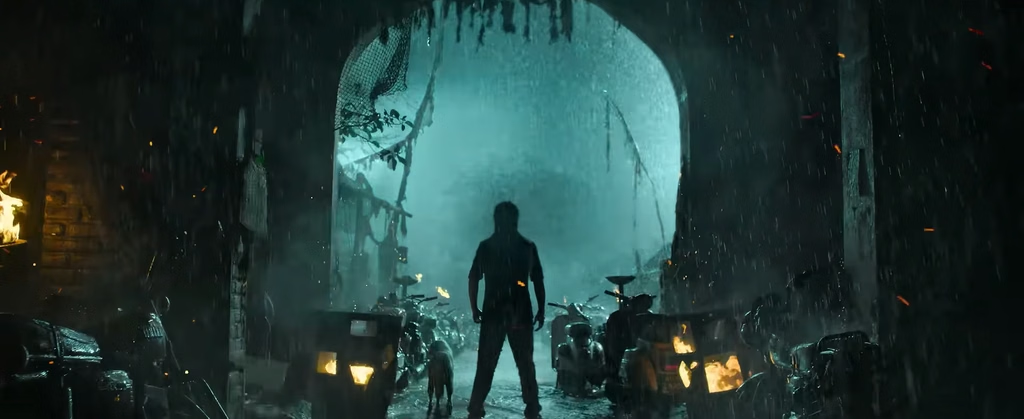
The film’s chapter-based structure is another example of style taking precedence over substance. Dividing the narrative into chapters could have created a distinctive storytelling rhythm, but the chapters do not always feel dramatically different enough to justify the structure. The transitions can also feel abrupt, with scenes sometimes ending before their emotional consequences have properly registered.
The problem becomes more obvious because the film’s production values are so strong. When a movie looks this expensive, weaknesses in the screenplay become even more visible. The camera can create an enormous world, but it cannot create character depth where the writing has not provided it. The music can make a scene feel bigger, but it cannot compensate for a dramatic conflict that has not been sufficiently developed.
The Second Half Is Where The Film Really Starts to Struggle
The first half has enough curiosity and momentum to keep you invested. You are learning about the Savaari community, understanding Jadal’s place within it and waiting to see how the conflict with Shikanja Malik develops. There is a sense that the film is building toward something substantial.
The second half does not maintain that momentum.
The narrative becomes more fragmented, and several scenes repeat emotional or thematic information that the audience already understands. Instead of constantly deepening the characters, the film keeps increasing the physical scale of the conflict. This is where The Paradise Movie Review becomes more critical because the problem is not simply pacing; it is dramatic progression. A long film can be perfectly engaging when every sequence changes the story or deepens our understanding of the characters. Here, too many sequences simply make the same point louder.
The climax also struggles to provide the emotional payoff that the story has been building toward. The action is large, but size is not the same thing as impact. A climax works when the audience cares deeply about what happens next. In The Paradise, the spectacle is often impressive, but the emotional payoff is considerably less satisfying.
Production Design and Cinematography Are Major Strengths
Visually, The Paradise is a far more accomplished film than its screenplay suggests. Avinash Kolla’s production design is one of the movie’s strongest departments, creating a convincing period environment that feels dense, lived-in and appropriately rough around the edges. The costumes, sets, locations and crowd scenes contribute significantly to the sense that this is a real community rather than a collection of sets built for an action movie.
CH Sai’s cinematography works particularly well during the large-scale action and landscape sequences. The film understands how to make its world look imposing. There is an obvious theatrical ambition behind many of the compositions, and the movie benefits from being seen on a large screen. This is one area where The Paradise Movie Review has very little criticism to offer. The visual department consistently communicates scale even when the narrative does not.
Music and Sound Design
Anirudh Ravichander’s songs add energy to the film and fit naturally into its larger mass-cinema identity. The background score, however, is less consistent. There are moments where the music successfully amplifies the intensity of the action, but there are also scenes where the score feels like it is working too hard to manufacture emotion.
Sound mixing is another issue that affects the viewing experience. The Indian Express noted that dialogue becomes difficult to hear in some of the more chaotic action passages. For a film that relies heavily on atmosphere and dramatic confrontations, dialogue clarity matters. When characters are saying something important and the soundscape overwhelms them, the emotional impact naturally suffers.
Editing and Screenplay Need More Control
Navin Nooli’s editing is uneven, particularly in the second half. The film’s chapter transitions sometimes feel abrupt, and certain scenes appear to end before their emotional beats have fully landed. That creates a strange rhythm in which the movie can feel simultaneously overlong and rushed.
That contradiction is one of the defining problems in The Paradise Movie Review. The film is approximately 165 minutes long, yet there are still moments when you wish certain characters had received more time. This usually means the issue is not simply runtime. It is allocation. The movie spends considerable time on spectacle while some character relationships and conflicts remain underdeveloped.
A more disciplined edit could have solved several problems at once. Removing repetitive action and tightening transitions would have created space for the characters to breathe. The film did not necessarily need a shorter story; it needed a more efficient one.
The Female Characters Are Underwritten
Kayadu Lohar and Sonali Kulkarni are both given opportunities to contribute more to the narrative, but the screenplay does not fully capitalize on them. Kayadu’s character is particularly underdeveloped, while Sonali Kulkarni’s role begins with emotional potential before gradually losing importance as the story becomes more action-heavy. This criticism has also appeared in published reviews of the film.
That is a major weakness because the world of The Paradise is large enough to support multiple perspectives. A marginalized community cannot feel fully realized if almost every meaningful decision ultimately revolves around the male protagonist. Giving the female characters more agency would not have weakened Jadal’s story. It would have made the entire community feel more alive.
Instead, The Paradise Movie Review finds the character writing noticeably uneven. Nani gets the transformation, the action and the dramatic arc. Several supporting characters get functions.
You should absolutely read this – 10 Best Hindi Web Series With Powerful Female Characters That Deserve Your Attention
The Paradise Movie Review: What Works
There is plenty here to admire if you separate the filmmaking departments from the screenplay. Nani’s physical transformation is convincing, and his performance carries the movie through several weaker stretches. The production design is excellent, the cinematography gives the film an impressive visual scale, and the action choreography delivers the theatrical spectacle promised by the marketing. Srikanth Odela also deserves credit for attempting something much larger in scale than Dasara. The film does not lack ambition.
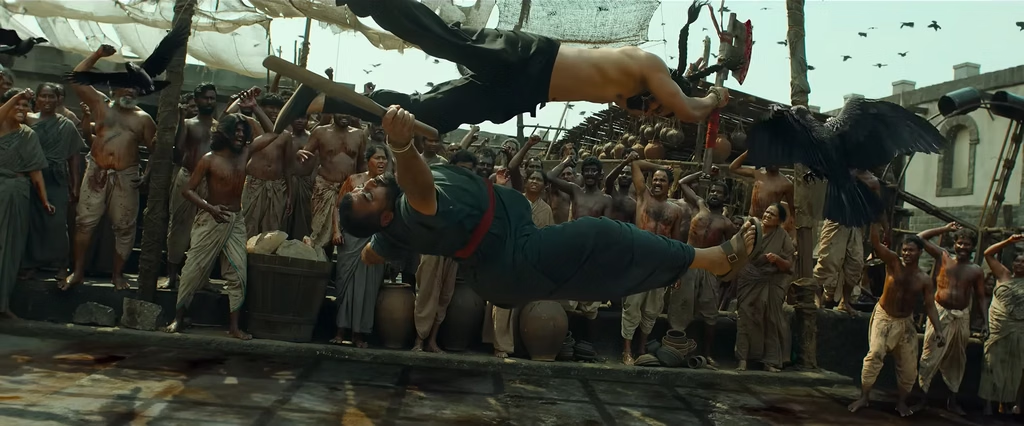
The setting is another strength. The Savaari community gives the story a distinct social context, and the Telangana-inspired elements provide the film with regional specificity. Odela has said that incidents from his own upbringing and experiences in Telangana influenced the film, which adds an interesting layer to the world-building.
The Paradise Movie Review: What Does Not Work
The biggest weakness is the predictable screenplay. The film uses a familiar saviour narrative without finding enough new character or thematic depth to distinguish it. The second half loses focus, the supporting cast is underused, several female characters are underwritten and the violence eventually becomes repetitive.
The film also struggles with emotional consistency. It wants the audience to care about Jadal’s personal journey, the Savaari community’s struggle and the larger conflict with Shikanja Malik, but it does not always connect those elements tightly enough. The result is a movie where the individual parts can be impressive while the whole remains frustratingly uneven.
That is why The Paradise Movie Review ultimately lands in the middle rather than at either extreme. Calling the film a disaster would ignore the technical craftsmanship and Nani’s performance. Calling it a major success would ignore the screenplay problems that repeatedly prevent the film from reaching its potential.
You may also like: 12 Best Indian Web Series Based on True Stories: Real Events, Shocking Crimes & Stories That Actually Happened
Is The Paradise Worth Watching?
If you are a Nani fan or someone who enjoys large-scale Telugu action cinema, I can understand the appeal of watching The Paradise in theatres. The production design is worth seeing on a big screen, the action sequences have genuine physicality, and Nani’s transformation is easily one of the film’s highlights. The film has enough theatrical moments to keep an action audience engaged.
However, viewers primarily interested in tightly written storytelling should moderate their expectations. The Paradise Movie Review is ultimately less enthusiastic about the story than the filmmaking. If you loved the rawness and emotional specificity of Dasara, this follow-up may feel frustrating because the scale has increased while the storytelling has become more conventional.
The film currently sits in the middle of a mixed critical response. The Indian Express rated it 2/5, India Today also gave it 2/5, while Times of India rated it 2.5/5. Across these reviews, Nani’s performance and the production values receive comparatively consistent praise, while the screenplay, characterization, pacing and emotional depth attract criticism.
Final Verdict: The Paradise Movie Review
The Paradise is a frustrating film because it is very easy to see the better movie hiding inside it. Srikanth Odela has created an impressive visual world, assembled a strong technical team and extracted a committed performance from Nani. The action works, the production design works and the central idea has genuine potential. But the screenplay does not consistently provide the characters with the depth necessary to make the spectacle emotionally powerful.
For me, that is the final takeaway from The Paradise Movie Review. This is not a film without ambition. It is a film where ambition has been successfully translated into scale but not consistently into storytelling. Nani gives Jadal a physical identity that stays with you, but the writing does not always give him an equally memorable emotional journey. Mohan Babu has the presence to be a formidable antagonist, but his character is underused. Raghav Juyal brings energy but receives limited material. The production design creates an excellent world, while the screenplay struggles to fill that world with equally compelling people.
The biggest disappointment is that the film’s social premise deserved greater attention. The Savaari community’s struggle for identity and recognition could have given The Paradise an emotional and political dimension that separated it from conventional mass action cinema. Instead, the story repeatedly moves toward familiar revenge and rebellion beats. The result is visually impressive but dramatically inconsistent.
So, The Paradise Movie Review verdict is straightforward: Nani is committed, the action has scale, the world looks terrific and Srikanth Odela clearly has ambition, but the screenplay is too familiar and the second half is too uneven to turn that ambition into a truly memorable film.
The Paradise Movie Review Rating: 2/5
Verdict: A technically impressive and visually ambitious action drama elevated by Nani’s commitment, but held back by a predictable screenplay, underwritten supporting characters and an uneven second half.
The Paradise Movie Review FAQs
What is The Paradise about?
The Paradise is set in 1980s Secunderabad and follows Jadal, played by Nani, against the backdrop of the Savaari community’s struggle for legal identity, dignity and recognition. The story brings together social conflict, family drama, rebellion and large-scale action.
What is the runtime of The Paradise?
The Paradise has a reported runtime of approximately 2 hours and 45 minutes, or 165 minutes.
Who plays the villain in The Paradise?
Mohan Babu plays Shikanja Malik, the feudal antagonist who holds power over the Savaari community. Raghav Juyal also plays an antagonist, Vikram Malik, in his Telugu film debut.
Is The Paradise worth watching in theatres?
For viewers who enjoy Nani, large-scale Telugu action films and strong production design, the theatrical experience has several attractions. The action and visuals are among the film’s stronger elements. Viewers primarily looking for a tightly written screenplay should be aware that the film has received criticism for its predictable story, uneven pacing and underdeveloped supporting characters.
What is the rating of The Paradise Movie Review?
The CineSyncs rating in this The Paradise Movie Review is 2.5/5. The rating reflects the film’s strong technical presentation and Nani’s performance while accounting for its screenplay, pacing and characterization issues.
What is the biggest strength of The Paradise?
Nani’s performance, the action choreography, production design and visual presentation are the film’s most notable strengths. Multiple reviews have particularly praised Nani’s physical transformation and the film’s technical craftsmanship.
What is the biggest weakness of The Paradise?
The screenplay is the biggest weakness. The story uses a familiar saviour-versus-oppressor structure, while the second half becomes uneven and several supporting characters are not developed enough.
Is The Paradise based on a true story?
It is not presented as a direct true-story adaptation, but director Srikanth Odela has said that several real-life incidents and experiences from Telangana influenced the film’s story and world.