
The Mahavatar Parshuram Announcement didn’t feel like a regular film update to me. It felt like a statement.
The moment I saw that first look released by Hombale Films, I wasn’t just watching a poster, I was looking at intent. A very clear intent: they are not here to make just another mythological film… they are building something long-term, something structured, something global.
And honestly, that’s where this announcement hits differently.

Mahavatar Parshuram Announcement Isn’t Just a Film, it’s a Universe Expanding
The Mahavatar Parshuram Announcement is not a standalone project. This is officially the second chapter of the Mahavatar Cinematic Universe, which already started with Mahavatar Narasimha.
That changes everything.
Because now we are not talking about one film, we are talking about a planned, interconnected mythological universe based on Vishnu’s avatars, something Indian cinema has never fully executed at this scale before.
When I understood this while reading about the Mahavatar Parshuram Announcement, my perspective shifted completely. This is not content. This is franchise-building.
What the First Look Made Me Feel (My Honest Reaction)
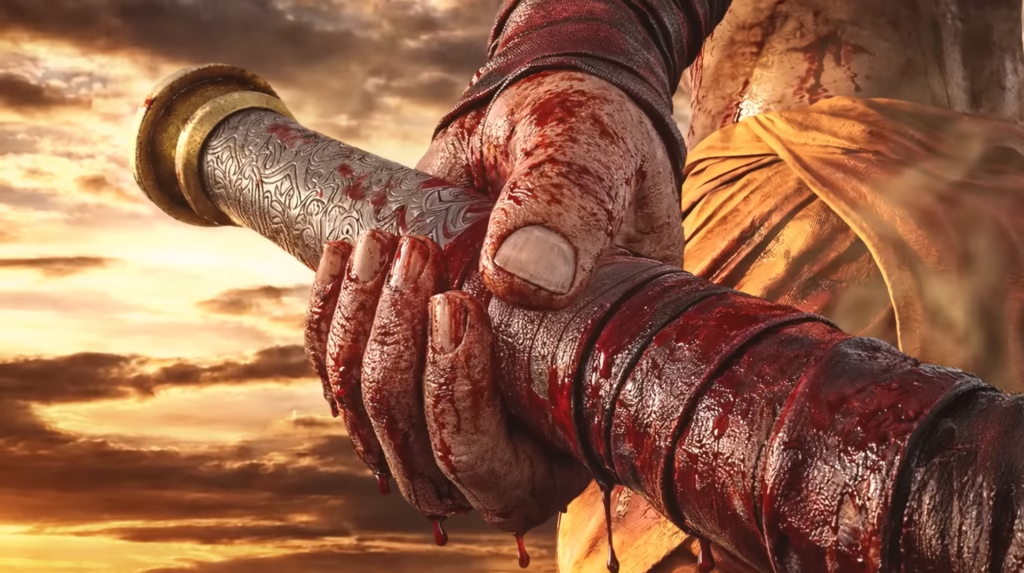
I’ll be very direct here. The first look from the Mahavatar Parshuram Announcement is intense. Not loud, not overdone just controlled aggression.
You can see a battle-ready Parshuram. There’s weight in the stance. There’s purpose. There’s anger but not chaos. And that’s important. Because Parshuram is not just a warrior. He’s a contradiction. A Brahmin with a weapon. A calm mind with violent consequences.
The visual actually hinted at that duality. It didn’t scream, it held back, and that made it more powerful. That’s rare.
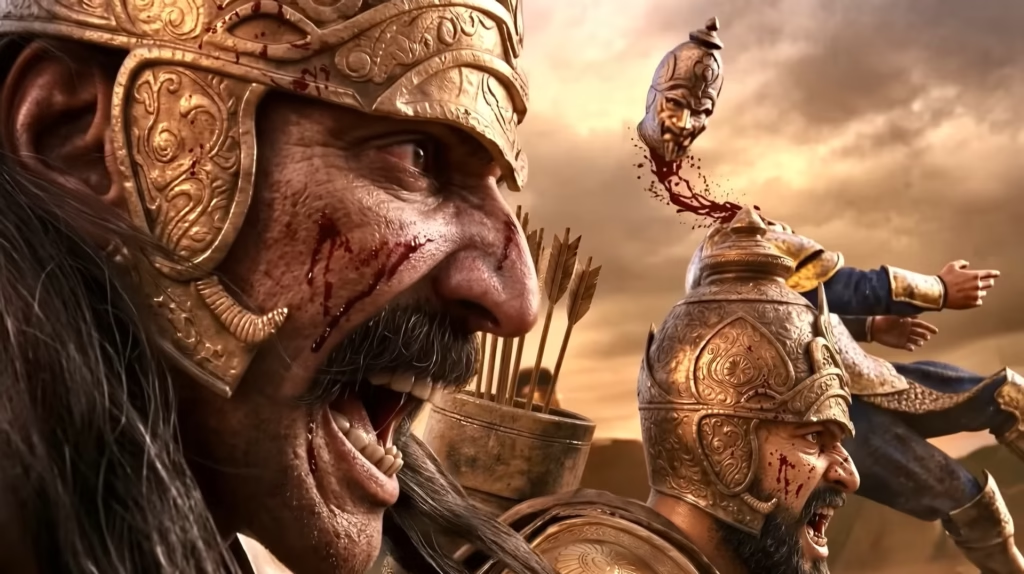
Director, Production & Why That Actually Matters Here
Let’s talk facts, because this is where the Mahavatar Parshuram Announcement becomes serious.
- Director: Ashwin Kumar
- Production: Hombale Films (KGF, Kantara, Salaar)
- Release Window: December 2027
Now pause for a second. This is the same studio that understands scale + emotion + rooted storytelling. They are not new to building cinematic worlds. And Ashwin Kumar already proved with Mahavatar Narasimha that he understands how to translate mythology into cinematic language that actually connects.
Also Here: Mahavatar Narsimha Movie Review (2025) – 7 Powerful Reasons Why It’s a Must-Watch Epic
So when I saw the Mahavatar Parshuram Announcement, I didn’t worry about whether it will look good.
My question became:
How far will they push this?
Why This Announcement Feels Strategically Smart
Most people are reacting to the visuals from the Mahavatar Parshuram Announcement, but when I looked at it more carefully, what stood out to me wasn’t just how it looked, it was how it’s being planned.
This doesn’t feel random. It feels structured.
The journey started with Mahavatar Narasimha, which already proved that this format can work both commercially and emotionally. Now, moving to Parshuram as the next chapter is not a coincidence. It’s a shift in tone from a powerful but contained narrative to something much darker, more intense, and psychologically layered.
And what really caught my attention is the long-term vision. This isn’t stopping here. The idea of eventually covering the full arc of Vishnu’s avatars, leading up to Kalki, clearly shows that this is being designed like a cinematic roadmap rather than a series of disconnected films.
That’s exactly how major global franchises were built not by chasing trends, but by planning years ahead. So when I look at the Mahavatar Parshuram Announcement, I don’t see hype. I see positioning.
The Risk: Why Parshuram Is Not an Easy Character
At the same time, I can’t ignore the risk here. The Mahavatar Parshuram Announcement is bold, but it’s stepping into dangerous territory because Parshuram is not a universally comfortable character. He doesn’t fit into a simple heroic mold.
He carries anger, but it’s not mindless.
He shows violence, but it comes from ideology.
He stands for justice, but his methods raise questions.

That complexity is exactly what makes him powerful but also what makes him difficult to portray.
If the film tries to simplify him too much, the character will lose depth and feel flat. If it blindly glorifies everything he does, it risks becoming one-dimensional. And if it leans too heavily into philosophy without emotional grounding, it could disconnect from the audience entirely.
So the challenge is not just storytelling, it’s balance. And honestly, this is where the film will either stand out… or fall apart.
Animation + Mythology = The Real Game Changer
One of the smartest decisions behind the Mahavatar Parshuram Announcement, in my opinion, is sticking with animation.
And not just animation for the sake of it but using it as a tool to expand storytelling.
Mythological narratives demand scale. They demand environments, battles, and visuals that go beyond realism. In live-action, achieving that consistently requires massive budgets and still comes with limitations. Animation removes that ceiling.
It allows the creators to fully commit to the world without compromise. Every frame can be controlled, every visual can match the tone, and the scale can remain consistent throughout the film.
After seeing how Mahavatar Narasimha performed, it’s clear that this approach is not experimental anymore. It’s a proven direction. So, this choice doesn’t feel risky it feels calculated.
What I Expect After This Announcement
After watching the Mahavatar Parshuram Announcement, my expectations are very clear and honestly, they are quite high. I’m not just looking for action or spectacle. That would be the easiest thing to deliver.
What I want is depth. I want to see the internal conflict of the character, not just his external battles. I want dialogues that carry meaning, not just impact. I want a soundtrack that enhances the emotional weight of scenes rather than just filling the silence.
At the same time, I’m cautious about certain things. If the film becomes too dependent on visual noise, it will lose its identity. If it tries too hard to create “mass moments,” it might feel forced. And if the storytelling stays on the surface, then even the strongest visuals won’t be enough.
Because a character like Parshuram demands more than just presentation, he demands understanding.
The Bigger Picture: This Could Redefine Indian Cinema
When I step back and look at the Mahavatar Parshuram Announcement from a broader perspective, it starts to feel bigger than just one film.
If this project works the way it’s intended to, it could push Indian animation into a completely new space. It could bring mythological storytelling back into mainstream cinema, but in a way that feels modern and globally competitive.
More importantly, it could influence how studios think. Instead of isolated projects, we might start seeing more long-term storytelling, more interconnected narratives, and more confidence in building cinematic universes rooted in Indian culture.
And that’s something the industry has been missing. Because the potential has always been there, we just haven’t seen it executed at this scale.
My Final Take on Mahavatar Parshuram Announcement
The Mahavatar Parshuram Announcement didn’t impress me because it was loud or flashy. It impressed me because it felt controlled.
Also Read: Mahavatar Parshuram first look unveiled by Hombale Films, makers confirm December 2027 release
There’s intent behind it. There’s planning behind it. And most importantly, there’s restraint. It doesn’t feel like a rushed attempt to capitalize on mythology. It feels like something that has been carefully designed with a long-term vision.
But at the end of the day, none of that will matter if the execution fails. Everything now depends on how honestly they handle the character, how deeply they explore the story, and whether they stay true to the tone they’ve set with this announcement. If they get that right, this film has the potential to become something truly significant.
Conclusion
The Mahavatar Parshuram Announcement is not loud, but it carries weight. It feels like a quiet signal to the industry that something serious is being built in the background.
Not rushed. Not reactive. But deliberate.
And now the only question that matters is, Will they actually deliver what this announcement promises?