
Mushtaq Khan Movies: Why His Supporting Roles Still Matter
When audiences remember a Bollywood film, the spotlight usually falls on the lead actors. Yet some of the scenes that survive for years belong to performers who were never positioned as the central attraction. Mushtaq Khan was one of those actors. His career was built around supporting parts, but his ability to give a character a distinct voice, physicality and comic rhythm often made a few minutes of screen time feel much bigger. Looking back at Mushtaq Khan Movies is therefore less about counting appearances and more about understanding why his characters stayed in the audience’s memory.
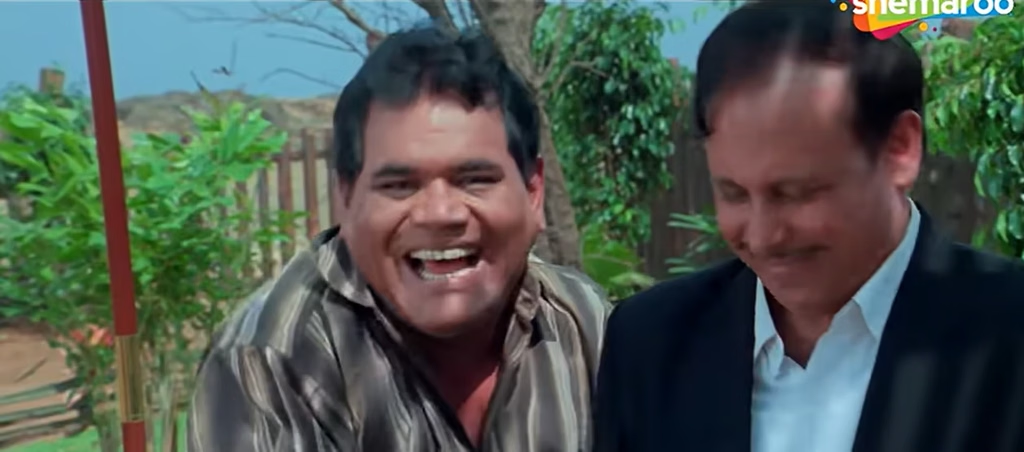
Mushtaq Khan made his screen debut with Albert Pinto Ko Gussa Kyoon Aata Hai in 1980 and worked across Hindi cinema for more than four decades. His filmography included dramas, action films, romances and comedies, while his television and later digital work expanded his reach further. His passing in September 2026 brought renewed attention to a body of work that many viewers had encountered repeatedly without always knowing the actor’s name. That is precisely what makes Mushtaq Khan Movies interesting: he was often the familiar face who quietly became part of a film’s identity.
What separates his best performances from ordinary supporting appearances is economy. Khan did not need a long character arc to establish someone. A particular expression, an oddly timed reaction, a dry delivery or a burst of nervous energy could be enough. His most successful characters also fit the tone of their films rather than feeling like detachable comic inserts. From Ballu in Welcome to Mishraji in Hum Hain Rahi Pyar Ke, the performances worked because Khan understood how much or how little a scene needed from him.
1. Ballu in Welcome — The Role That Became a Cult Favourite
Among all Mushtaq Khan Movies, Welcome is the obvious starting point. In Anees Bazmee’s 2007 comedy, Khan played Ballu, an associate of Nana Patekar’s Uday Shetty. The film already had an extraordinary comic ensemble, with Anil Kapoor, Paresh Rawal, Akshay Kumar and Nana Patekar creating characters that could easily dominate every scene. Khan nevertheless found a way to make Ballu instantly recognisable.
The secret was not simply the famous artificial-leg story. It was the manner in which Khan built the joke. Ballu speaks with the confidence of someone telling an important personal history, while the absurdity of the story keeps escalating. Khan’s straight-faced delivery gives the scene its rhythm, and the character’s physicality makes the dialogue even more memorable. The performance is a textbook example of how a supporting actor can turn a short sequence into a piece of pop-culture memory.
The role became so closely associated with Khan that he reprised Ballu in Welcome Back in 2015. For anyone searching through Mushtaq Khan Movies, the Welcome films remain essential viewing because they show his instinct for ensemble comedy at its sharpest.
For readers searching Mushtaq Khan Movies, this is the performance that should come first. That combination makes Welcome one of the defining titles among Mushtaq Khan Movies.
2. Gul Khan in Gadar: Ek Prem Katha — A Different Kind of Supporting Presence
If Welcome showed Khan’s comic strengths, Gadar: Ek Prem Katha showed how naturally he could operate inside a much more dramatic world. Released in 2001, Anil Sharma’s period action drama starred Sunny Deol and Ameesha Patel, but Khan’s Gul Khan became one of the supporting faces audiences associated with the film.
Gul Khan works because the character belongs to the world of the story. Khan does not play him like a comedian waiting for a punchline. Instead, he contributes to the film’s atmosphere and the larger conflict surrounding Tara Singh. That distinction matters when evaluating Mushtaq Khan Movies because his career was never limited to comedy, even though comedy eventually became one of his most recognisable strengths.
More than two decades later, Khan returned as Gul Khan in Gadar 2. The sequel gave audiences a chance to see the character again while reconnecting the performer with a franchise that had become part of Hindi cinema’s mainstream culture. The two films together demonstrate Khan’s consistency: he could return to a familiar character without making the performance feel like a simple cameo.
The Gadar films also show why Mushtaq Khan Movies cannot be reduced to comedy alone.
3. Rafoo Master in Aashiqui — An Early Memorable Performance
Before the comic roles that made him widely recognisable, Mushtaq Khan was already building a reputation through supporting characters. Mahesh Bhatt’s Aashiqui, released in 1990, is one of the most important examples. Khan played Rafoo Master in the romantic musical starring Rahul Roy and Anu Aggarwal.
Aashiqui is remembered primarily for its love story and its landmark soundtrack, but the film also depends on a colourful supporting world around its central couple. Khan’s Rafoo Master contributes to that texture. His appearance is not designed to compete with the protagonists; it works because he gives the surrounding world a sense of lived-in personality.
This is an important part of the story behind Mushtaq Khan Movies. His career was not built overnight through one blockbuster. It developed through repeated appearances in films where he understood the assignment of a character actor: enter the story, establish the character quickly and make the scene feel inhabited.
Among Mushtaq Khan Movies from the early 1990s, Aashiqui remains an important milestone.
4. Bhagwati Prasad Mishra in Hum Hain Rahi Pyar Ke — The Turning Point for His Comedy
Hum Hain Rahi Pyar Ke is arguably one of the most significant titles when discussing Mushtaq Khan Movies because Khan himself later credited the film with opening the door to more light-hearted comedy roles. In Mahesh Bhatt’s 1993 romantic comedy-drama, he played Bhagwati Prasad Mishra, commonly referred to as Mishraji.
The performance works because Mishraji is not written as a one-note clown. Khan uses his expressions and conversational timing to fit naturally into the film’s comic environment. His performance became important enough in retrospect that Khan discussed how the success of the film helped him receive more opportunities in light-hearted characters.
That makes Hum Hain Rahi Pyar Ke more than another entry in a list of Mushtaq Khan Movies. It represents a career shift. The actor had already appeared in serious and dramatic material, but the film helped audiences and filmmakers recognise another side of his screen personality. His later comedy work makes more sense when viewed through this transition.
This is one of the reasons Hum Hain Rahi Pyar Ke belongs near the top of Mushtaq Khan Movies.
5. Devi Prasad’s Servant in Hera Pheri — Small Role, Perfect Comic Placement
Hera Pheri is filled with performances that have become part of Hindi comedy culture, and Khan’s role is much smaller than those of Akshay Kumar, Suniel Shetty, Paresh Rawal and Tabu. Yet his appearance as Devi Prasad’s servant is a useful example of how Khan could make even a brief supporting role fit the larger comic machinery.
The strength here is restraint. Khan does not attempt to manufacture a separate comedy track around himself. Instead, he supports the scene and reacts to the principal characters. That may sound simple, but ensemble comedy depends heavily on performers who know how to listen, react and leave space for the main joke to land.
For fans revisiting Mushtaq Khan Movies, the Hera Pheri appearance is an easy one to rediscover. Among Mushtaq Khan Movies, Hera Pheri is valuable for exactly this reason. It demonstrates that his craft was not only about delivering a memorable line. He could also contribute through timing, reactions and the texture of a scene.
Also Read: Drishyam 3 Review: 7 Powerful Reasons Why The Conclusion Keeps You Guessing
6. Chutki Baba in Mujhse Shaadi Karogi — His Comic Persona in Full Flight
David Dhawan’s Mujhse Shaadi Karogi gave Khan another opportunity to work inside a deliberately exaggerated comedy. He appeared as Chutki Baba in the 2004 Salman Khan, Akshay Kumar and Priyanka Chopra Jonas starrer.
The film thrives on broad personalities and escalating misunderstandings, and Khan fits that world without disturbing its rhythm. Chutki Baba is memorable because the performance embraces the comic absurdity rather than trying to make the character more realistic than the screenplay requires.
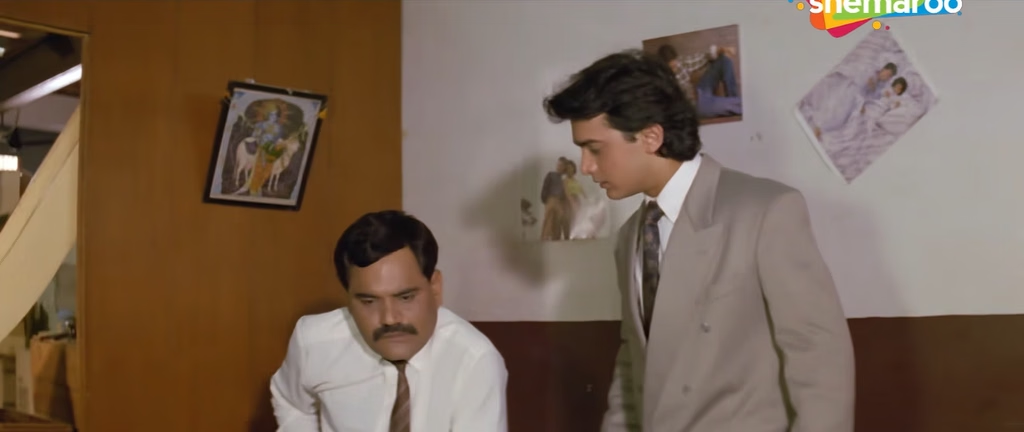
This is another reason Mushtaq Khan Movies remain useful for understanding Bollywood’s ensemble tradition. Character actors often have to calibrate their performances against stars with enormous screen presence. Khan’s advantage was his willingness to commit fully to the tone of a scene. He could be eccentric without making the performance feel disconnected from the movie around him.
It is another reason Mujhse Shaadi Karogi deserves a place in any list of Mushtaq Khan Movies.
7. Bus Conductor in Dil Hai Ki Manta Nahin — A Brief Appearance With Personality
Mahesh Bhatt’s Dil Hai Ki Manta Nahin, released in 1991, features Khan as a bus conductor. The role is brief, but it belongs on a list of Mushtaq Khan Movies because it shows the actor during an earlier stage of his career, when he was already accumulating varied supporting credits.
What makes the appearance interesting is how naturally Khan fits into the film’s road-journey structure. The character is not there to transform the plot; he helps make the journey feel populated and believable. This kind of work rarely receives enough attention because it disappears into the larger movie, but it is precisely the kind of performance that helped Khan become a dependable character actor.
Looking across Mushtaq Khan Movies from this period, you can see an actor willing to move between genres rather than locking himself into one type of role. The film is easy to overlook, but it adds useful context to Mushtaq Khan Movies from his early career.
8. The Pimp in Sadak — A Darker Side of His Filmography
Sadak offered Khan a very different register. In Mahesh Bhatt’s 1991 film, he played a pimp, a role far removed from the cheerful supporting characters for which many viewers later knew him.
The performance matters because it challenges the idea that Khan was simply a comic actor. His early filmography contains characters connected to crime, conflict and social darkness. He could play unpleasant or morally compromised figures without the performance becoming cartoonish.
This darker side is one reason Mushtaq Khan Movies are worth revisiting chronologically. If you start with Welcome and move backward, it becomes clear that the actor’s comic reputation was only one chapter of a much broader career. The range is more impressive when the films are viewed together.
Sadak also broadens the picture presented by Mushtaq Khan Movies beyond familiar comedy.
9. Lawyer Raina in Bala — A Later-Period Reminder of His Versatility
In Amar Kaushik’s Bala, Khan played Lawyer Raina. Released in 2019, the film combined social commentary with mainstream comedy, and Khan’s appearance was another example of his ability to slide into an ensemble without demanding unnecessary attention.
The role is not as iconic as Ballu, but it is useful when examining Mushtaq Khan Movies because it shows how his screen persona had matured. By this stage, audiences could recognise him immediately, yet he remained capable of serving the story rather than repeating the exact same comic character.
That distinction becomes important when discussing legacy. Longevity in Bollywood is not simply about appearing in a large number of films. It is about remaining useful to different kinds of filmmakers and stories. Khan managed that for decades.
Bala is a reminder that later Mushtaq Khan Movies still benefited from his dependable character work.
10. MLA/Neta in Stree 2 — A Late-Career Scene-Stealer
One of the most recent memorable entries in Mushtaq Khan Movies is Stree 2, where he played an MLA/Neta. Amar Kaushik’s horror-comedy already had a strong ensemble led by Rajkummar Rao, Shraddha Kapoor, Pankaj Tripathi, Aparshakti Khurana and Abhishek Banerjee, so Khan once again had to make an impression within a crowded comic landscape.
His appearance works because the character immediately belongs to the exaggerated social world of the film. Khan brings the same instinct for comic reaction and timing that defined some of his earlier work, but the performance also carries the ease of an actor who knows exactly how to enter an ensemble and leave an impression.
For viewers exploring Mushtaq Khan Movies today, Stree 2 is particularly interesting because it places him in a contemporary franchise while showing that his basic strength had not changed: he could turn a supporting character into a recognisable part of the film’s personality.
You may also like: 10 Best Hindi Web Series With Powerful Female Characters That Deserve Your Attention
What Made Mushtaq Khan So Effective?
The most interesting thing about Mushtaq Khan Movies is that his performances rarely depend on conventional star power. He was not usually the person the audience came to see, but he was often one of the people they remembered. That requires a specific kind of screen intelligence.
First, Khan understood timing. Comedy is not simply about saying something funny; it is about when the line is delivered, how long the reaction lasts and whether the actor knows when to stop. Khan was particularly good at that rhythm.
Second, he had a strong sense of character detail. Ballu is not memorable only because of one dialogue. Mishraji is not memorable only because the film is funny. These characters have voices, mannerisms and reactions that make them identifiable.
Third, Khan understood ensemble acting. In films such as Welcome, Hera Pheri and Stree 2, he worked alongside performers with very strong comic identities. Instead of fighting for the spotlight, he contributed to the collective rhythm. That is a difficult skill, and it explains why so many Mushtaq Khan Movies continue to be revisited.
The breadth of Mushtaq Khan Movies is what makes his career especially worth revisiting. Even the less famous Mushtaq Khan Movies can reveal another side of his acting technique.
Mushtaq Khan Movies: The Legacy of a True Character Actor
The best way to remember Mushtaq Khan is not as the actor who played one famous role, but as a performer who accumulated dozens of recognisable moments. His filmography stretches from Albert Pinto Ko Gussa Kyoon Aata Hai in 1980 through major Hindi films across the 1990s, 2000s and 2010s, into later projects such as Stree 2, Dhoom Dhaam and Jaat. His work also extended beyond cinema into television and digital entertainment.
There is a reason viewers often recognise his face before remembering his name. That is the paradox of the great character actor: they become part of the visual memory of an era without necessarily becoming conventional stars. Mushtaq Khan Movies capture that career particularly well because the range is visible only when the films are considered together.
His passing in September 2026 has naturally encouraged audiences to revisit those performances. And when you do, the most striking discovery is not that Khan appeared in so many films. It is that he repeatedly found a way to make small roles feel complete. Whether he was making an audience laugh, adding texture to a dramatic world or simply giving a passing character a little personality, he brought a recognisable human quality to the screen.
Taken together, these Mushtaq Khan Movies reveal an actor who could adapt without losing his identity.
Read more from Wikipedia: Mushtaq Khan – Wikipedia
Final Verdict
If you want to explore Mushtaq Khan Movies, start with Welcome, Gadar: Ek Prem Katha, Aashiqui, Hum Hain Rahi Pyar Ke, Hera Pheri, Mujhse Shaadi Karogi, Dil Hai Ki Manta Nahin, Sadak, Bala and Stree 2. Together, these films reveal the range behind a performer who was much more than a familiar supporting face.
Mushtaq Khan’s greatest strength was his ability to make the audience notice the character without making the performance feel forced. That is why Ballu still gets remembered, why Mishraji remains an important step in his comic career, and why even smaller appearances can stand out decades later. His legacy is ultimately the legacy of the character actor: not always at the centre of the poster, but often somewhere inside the scene people remember most.
For a character-actor retrospective, Mushtaq Khan Movies offer an unusually clear career arc. That career arc is visible across Mushtaq Khan Movies from the 1980s to his later screen work.
FAQs About Mushtaq Khan Movies
What are the best Mushtaq Khan Movies to watch first?
Welcome is the best starting point because Ballu remains his most widely remembered comic role. After that, Gadar: Ek Prem Katha, Aashiqui, Hum Hain Rahi Pyar Ke, Hera Pheri and Stree 2 provide a useful picture of his range.
Which is Mushtaq Khan’s most famous role?
Ballu in Welcome is arguably his most famous role. His artificial-leg and hockey monologue became one of the film’s most quoted comic sequences, and he reprised Ballu in Welcome Back.
Did Mushtaq Khan play Gul Khan in Gadar?
Yes. Khan played Gul Khan in Gadar: Ek Prem Katha and returned as the same character in Gadar 2.
Which Mushtaq Khan role helped establish his comedy image?
Bhagwati Prasad Mishra, or Mishraji, in Hum Hain Rahi Pyar Ke was particularly important. Khan later said the film opened the door to more light-hearted comedy roles for him.
Was Mushtaq Khan only a comedy actor?
No. His filmography includes serious and darker characters as well as comedy. His role as the pimp in Sadak and his appearance in Gadar: Ek Prem Katha are good examples of his range.
Which recent film features Mushtaq Khan as an MLA?
Mushtaq Khan played an MLA/Neta in Stree 2, the 2024 horror-comedy directed by Amar Kaushik.
Why are Mushtaq Khan Movies still popular?
The strongest Mushtaq Khan Movies remain popular because his characters are easy to remember. His comic timing, expressive reactions and ability to establish a personality quickly allowed even supporting roles to leave a lasting impression.
What is the best way to explore Mushtaq Khan’s filmography?
A chronological mix works best. Watch Aashiqui and Dil Hai Ki Manta Nahin for his earlier supporting work, Hum Hain Rahi Pyar Ke for an important comedy turning point, then move through Hera Pheri, Gadar, Welcome, Bala and Stree 2 to see how his screen identity evolved over the decades.