
There are some actors whose performances become memories, and then there are actors whose performances become part of the language of cinema itself. Nana Patekar belonged to the second category. On October 8, 2026, Indian cinema lost one of its most distinctive, fearless and uncompromising performers when Nana Patekar died at the age of 75 after suffering a cardiac arrest at his residence in Goa. Despite efforts to revive him, he could not be saved.
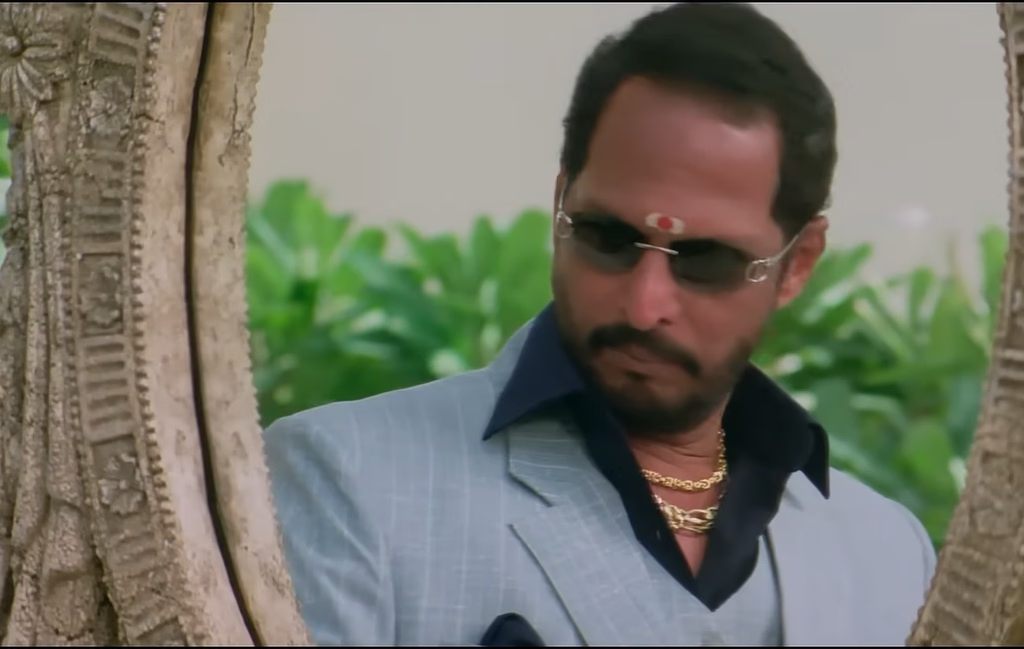
The news of Nana Patekar’s death feels particularly painful because Indian cinema is losing an artist who never needed the conventional machinery of stardom to command attention. He did not depend on glamour, elaborate introductions or the image of a traditional leading man. Nana Patekar could walk into a scene, say a few words in that unmistakable voice, and completely change its temperature. His eyes, pauses, body language and explosive dialogue delivery often did more than an entire sequence built around spectacle.
As tributes poured in from across the film industry, the scale of the loss became increasingly clear. Nana Patekar leaves behind nearly five decades of work across Hindi and Marathi cinema, theatre and filmmaking. He won three National Film Awards and received the Padma Shri in 2013, but awards alone cannot adequately explain his importance. His greatest achievement was creating a screen presence that was unmistakably his own.
Nana Patekar Dies at 75 After Cardiac Arrest
According to reports, Nana Patekar was found unresponsive at his residence in Goa early on Thursday morning. He had reportedly complained of severe chest pain, after which medical assistance was called. Doctors attempted to revive him, but the efforts were unsuccessful. He was declared dead at approximately 5:20 AM.
The actor’s mortal remains were later taken to Pune, where his final rites were scheduled with state honours. The Maharashtra government’s decision to accord Nana Patekar a state funeral reflects the enormous cultural contribution he made over the course of his career.
The circumstances of Nana Patekar’s final hours have understandably dominated the immediate coverage, but an obituary should not allow the manner of an artist’s death to overshadow the life of work that came before it. Nana Patekar’s story is ultimately a story about acting, theatre, cinema and an extraordinary commitment to authenticity.
Nana Patekar Was Never a Conventional Bollywood Star
Born Vishwanath Patekar on January 1, 1951, in Maharashtra, Nana Patekar began his journey through theatre before establishing himself in cinema. His film career began with Gaman in 1978, but his rise was gradual rather than overnight. His theatre background remained an important part of his artistic identity, and it helped shape the raw, disciplined approach that later became his trademark on screen.
What made Nana Patekar different was his refusal to fit neatly into one category. He could play a morally complicated protagonist, a terrifying antagonist, a police officer, a political figure, a troubled father or an absurdly funny gangster without making the performances feel like variations of the same character.
That versatility is particularly impressive because Nana Patekar developed one of the most recognisable acting styles in Indian cinema. His voice had an inherent authority, but his performances were not dependent on shouting. Some of his most effective moments came when he barely raised his voice. A pause, a stare or a restrained reaction could communicate as much anger and vulnerability as a long monologue.
This is why discussing Nana Patekar only as an “intense actor” would actually undersell his range. Intensity was certainly part of his artistic vocabulary, but it was never the entirety of it.
Parinda Established Nana Patekar as a Major Force
One of the defining turning points in Nana Patekar’s career came with Vidhu Vinod Chopra’s Parinda in 1989. His performance earned him the National Film Award for Best Supporting Actor and established him as one of the most formidable performers of his generation.
Parinda demonstrated something audiences would repeatedly discover throughout Nana Patekar’s career: he could make a supporting role feel central to the emotional architecture of a film.
His performance did not rely simply on playing a villain. There was menace, psychological instability and a strange vulnerability beneath the character. Nana Patekar understood that a dangerous character becomes far more frightening when the audience can sense the human being underneath the violence.
That quality became one of the foundations of Nana Patekar’s career. Even when his characters were extreme, they rarely felt like cardboard villains or predictable heroes.
Krantiveer Gave Nana Patekar One of His Defining Performances
If Parinda announced Nana Patekar as a major talent, Krantiveer turned him into a national phenomenon. His performance as Pratap Narayan Tilak remains one of the defining performances of 1990s Hindi cinema and earned him the National Film Award for Best Actor.
The film demanded enormous emotional and physical commitment, and Nana Patekar responded with a performance that was confrontational without becoming hollow. His famous dialogue delivery became a major part of the film’s identity, but the performance worked because there was genuine emotional conviction behind those words.
This is an important distinction when remembering Nana Patekar. His dialogue delivery was never simply about volume. He understood rhythm, emphasis and silence. He knew when to push a line and when to let a pause carry the emotional weight.
That is why so many Nana Patekar scenes continue to circulate decades after their original release. They are not merely remembered as dialogues; they are remembered as performances.
From Khamoshi to Ab Tak Chhappan: A Performer Who Kept Reinventing Himself
Nana Patekar continued to explore dramatically different characters throughout the 1990s and 2000s. His work in Khamoshi: The Musical, Agni Sakshi, Ab Tak Chhappan, Apaharan and Raajneeti demonstrated that he was far more versatile than the “angry actor” label sometimes suggested.
His performance in Agni Sakshi earned him another National Film Award for Best Supporting Actor, giving Nana Patekar a remarkable three National Film Awards across his career.
Then came Ab Tak Chhappan, where Nana Patekar played Sadhu Agashe, a police officer whose professional efficiency existed alongside considerable psychological complexity. The performance was controlled, understated and intimidating in a completely different way from some of his earlier work.
Nana Patekar had become particularly effective at portraying men carrying emotional baggage. His characters often appeared tough on the outside while revealing cracks underneath. That ability to communicate internal conflict without excessive exposition became one of his strongest qualities as an actor.
And Then Nana Patekar Made Everyone Laugh in Welcome
For an actor so strongly associated with serious and intense cinema, Nana Patekar’s transformation into Uday Shetty in Welcome was a masterstroke.
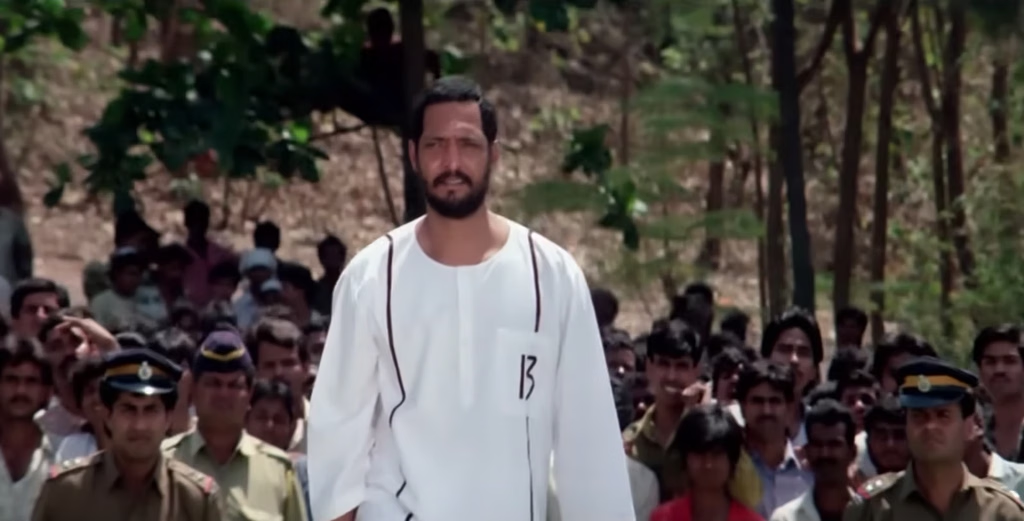
Released in 2007, Anees Bazmee’s Welcome gave Nana Patekar an opportunity to demonstrate a side of his personality that audiences had not always been able to see. As Uday Shetty, he became one of the film’s biggest comic attractions alongside Anil Kapoor.
The remarkable thing was that Nana Patekar did not abandon his intensity to become funny. He used it.
Uday Shetty is hilarious precisely because Nana Patekar plays the gangster’s absurd situations with absolute seriousness. His facial expressions, timing and irritated reactions became comedy weapons. The character eventually entered popular culture, with scenes and dialogues continuing to circulate among younger audiences years after the film’s release.
This was another reminder that Nana Patekar could dominate a scene regardless of genre.
He could frighten you in Parinda, inspire you in Krantiveer, unsettle you in Ab Tak Chhappan and then make you laugh uncontrollably as Uday Shetty. Very few actors have demonstrated that kind of range while maintaining such a distinctive personal identity.
Natsamrat Showed the Depth of Nana Patekar
For many admirers of Nana Patekar, Natsamrat represents something even more personal.
The 2016 Marathi film allowed Nana Patekar to return to the world of theatre through the character of Ganpatrao Belwalkar, a retired stage actor confronting the emotional consequences of ageing, family relationships and the loss of the world he once dominated.
The performance was deeply theatrical, but it never felt trapped inside theatricality. Nana Patekar brought decades of experience to the character, allowing small gestures and moments of silence to communicate enormous emotional weight.
Natsamrat also demonstrated why Nana Patekar remained so important to Marathi cinema. His identity was never limited to Bollywood. Theatre and Marathi cinema were fundamental parts of his artistic journey, and his work in both mediums helped establish him as an actor whose reputation extended far beyond mainstream Hindi cinema.
Nana Patekar Was Also a Filmmaker
It is easy to forget that Nana Patekar was not only an actor.
In 1991, he made his directorial debut with Prahaar: The Final Attack, a film that he also wrote and starred in. The film reflected his interest in discipline, military life and the psychological consequences of violence.
His filmmaking career was not as extensive as his acting career, but it remains an important part of understanding Nana Patekar as an artist. He was never simply a performer waiting for somebody else to tell him what a character should be. He had strong opinions about storytelling, realism and human behaviour, and those instincts frequently informed his performances.
Also Read: Nana Patekar dies: From Parinda to Welcome, a look back at the actor’s legendary career
Nana Patekar’s Legacy Goes Beyond Cinema
One of the most important parts of Nana Patekar’s legacy exists outside the film industry.
In 2015, Nana Patekar and actor Makarand Anaspure established the Naam Foundation, which worked to support farmers and drought-affected communities in Maharashtra. His involvement in social work reflected another side of a public figure often associated with fiery performances and blunt opinions.
Nana Patekar also supported Indian shooting and helped young athletes with equipment and other assistance. Indian shooter Anjali Bhagwat recalled how his support helped her during a period when athletes faced financial limitations.
These contributions matter because they show that Nana Patekar’s influence was never confined to the screen. The same intensity that audiences saw in his performances was accompanied by a strong sense of social responsibility away from the camera.
Also Read: 10 Mushtaq Khan Movies With His Most Memorable Roles: The Powerful Scene-Stealer You Should Remember
Remembering Nana Patekar: An Actor Who Could Not Be Replaced
Indian cinema has produced countless stars, but very few actors have possessed a presence as immediately identifiable as Nana Patekar.
You could hear his voice without seeing his face and know who was speaking. You could watch a few seconds of his body language and recognise the performer. Yet beneath that unmistakable identity was an actor capable of extraordinary transformation.
Nana Patekar understood something fundamental about acting: a character does not become memorable simply because the actor performs loudly. A character becomes memorable when the actor gives that person a life beyond the screenplay.
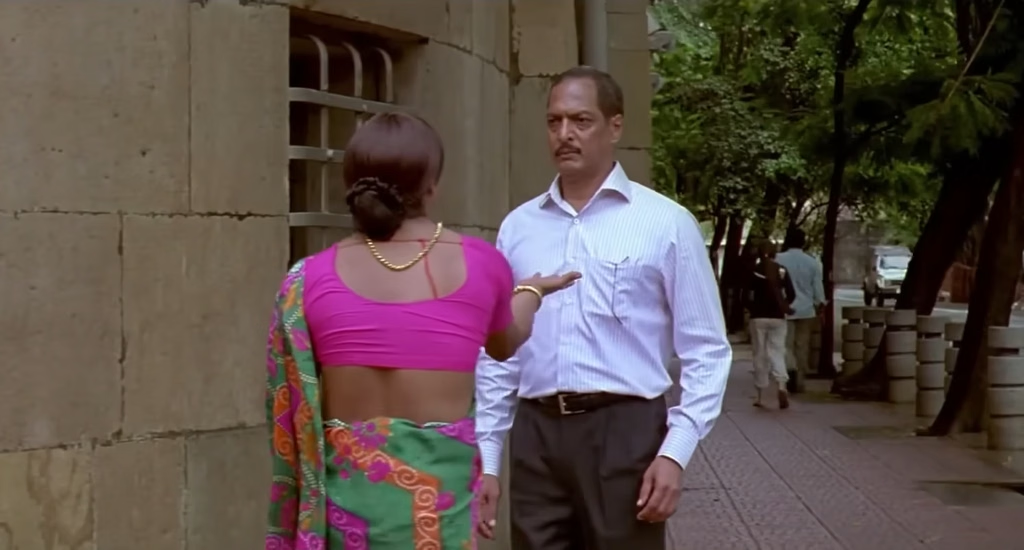
That is what Nana Patekar repeatedly accomplished.
His career moved between theatre and cinema, Hindi and Marathi films, serious dramas and broad comedies, heroes and villains, fictional characters and real-life figures. He portrayed police officers, gangsters, politicians, soldiers, doctors and ordinary men struggling with extraordinary circumstances. He could play a character who dominated the room and another whose pain was expressed almost entirely through silence.
For younger generations discovering Nana Patekar through Welcome, his older films offer a much larger picture of the artist. For audiences who grew up watching Parinda, Krantiveer, Khamoshi, Ab Tak Chhappan and Natsamrat, his death represents the loss of a performer whose work became part of their cinematic memories.
And that is perhaps the most fitting way to remember Nana Patekar.
Not simply as a National Award winner. Not simply as the man behind Uday Shetty. Not simply as the intense voice of 1990s Hindi cinema.
Remember him as an actor who refused to become ordinary.
Nana Patekar Death: A Loss That Will Be Felt for Generations
The immediate shock surrounding Nana Patekar’s death will eventually give way to retrospectives, television tributes, social-media memories and renewed interest in his films. That is how cinema remembers its legends.
But the most meaningful tribute will be simpler: watching his films again.
Watch Parinda and observe how he builds menace. Watch Krantiveer and study the conviction behind the performance. Watch Ab Tak Chhappan for the restraint. Watch Welcome for the comic timing. Watch Natsamrat for the emotional depth. Taken together, these performances reveal an actor who never allowed one successful image to define him completely.
Nana Patekar died at 75, but his performances do not belong to the past. They remain available to every new generation of viewers willing to discover what made him special.
Also Read: Drishyam 3 Review: 7 Powerful Reasons Why The Conclusion Keeps You Guessing
The industry has lost an extraordinary actor. Indian cinema has lost one of its most original voices. And audiences have lost a performer whose presence could make even an ordinary scene feel important.
Our deepest condolences to Nana Patekar’s family, friends, colleagues and millions of admirers across India.
Om Shanti.
Nana Patekar Movies: 7 Performances Worth Revisiting
If Nana Patekar’s death has inspired you to revisit his work, these seven films offer a strong introduction to the range of his career:
- Parinda (1989) – The performance that earned Nana Patekar his first National Film Award.
- Krantiveer (1994) – One of his most powerful leading performances and a National Award-winning role.
- Khamoshi: The Musical (1996) – A reminder of his ability to bring emotional complexity to mainstream drama.
- Ab Tak Chhappan (2004) – A controlled and memorable performance as police officer Sadhu Agashe.
- Apaharan (2005) – Another strong example of Nana Patekar’s ability to inhabit morally complicated characters.
- Welcome (2007) – His brilliantly comic turn as Uday Shetty introduced his work to an entirely new generation.
- Natsamrat (2016) – One of the finest showcases of Nana Patekar’s emotional and theatrical abilities.
Frequently Asked Questions
How old was Nana Patekar when he died?
Nana Patekar was 75 years old when he died on October 8, 2026.
How did Nana Patekar die?
Nana Patekar died after suffering a cardiac arrest at his residence in Goa. Doctors attempted to revive him, but he could not be saved.
What was Nana Patekar’s first film?
Nana Patekar made his film debut with Gaman in 1978.
How many National Film Awards did Nana Patekar win?
Nana Patekar won three National Film Awards during his career: for Parinda, Krantiveer and Agni Sakshi.
What is Nana Patekar’s most famous role?
There is no single answer because Nana Patekar had several iconic performances. His roles in Parinda, Krantiveer, Ab Tak Chhappan, Natsamrat and Welcome are among his most widely remembered performances.
Did Nana Patekar direct any films?
Yes. Nana Patekar made his directorial debut with Prahaar: The Final Attack in 1991, in which he also acted and wrote.
What was Nana Patekar’s role in Welcome?
Nana Patekar played Uday Shetty, a gangster whose serious personality and explosive reactions became one of the major sources of comedy in Welcome. He reprised the character in Welcome Back.
What was Nana Patekar’s contribution outside cinema?
Nana Patekar was involved in social work, most notably through the Naam Foundation, which he co-founded with Makarand Anaspure to support farmers and drought-affected communities in Maharashtra.
Final Tribute
Nana Patekar leaves behind something more valuable than celebrity: a body of work that continues to teach audiences what great acting can look like.
He was fierce without being artificial, emotional without becoming sentimental and funny without losing his identity. His performances carried the unmistakable imprint of an actor who trusted the character more than the conventions of stardom.
Indian cinema will continue to produce stars. It will continue to produce successful actors. But an artist like Nana Patekar is much harder to replace.
Farewell, Nana Patekar. Your films remain, your characters remain, and your voice will continue to echo through Indian cinema.